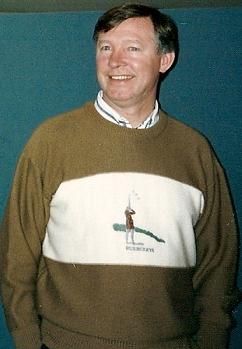
Before Manchester United
Ferguson's pre-United career was already substantial. He had played as a forward in Scotland, moved into management with East Stirlingshire and St Mirren, then built Aberdeen into a side capable of breaking the Old Firm's domestic control and winning in Europe.
That history is essential to understanding why United appointed him in 1986. He was not an experimental choice or a manager hired on potential alone; he had already won league titles, Scottish Cups, the European Cup Winners' Cup and the European Super Cup, and had shown he could change the mentality of an entire club.
Govan, Work And The Making Of A Footballer
Alexander Chapman Ferguson was born in Govan, Glasgow, on 31 December 1941, into a part of the city shaped by shipbuilding, heavy industry and football. His father worked in the shipyards and Ferguson's own early life followed a familiar Glasgow rhythm: school, work, local football, and a strong sense that reputation had to be earned every day. That background is often treated as a footnote to his success, but it matters. The discipline, bluntness and suspicion of complacency that later defined him as a manager were not theatrical devices; they were rooted in the working culture he came from.
His playing career began at Queen's Park, where he was an amateur forward, before spells with St Johnstone and Dunfermline Athletic. At Dunfermline he became one of the leading goalscorers in Scotland, combining penalty-box aggression with the competitive edge that later became his managerial signature. He moved to Rangers in 1967, a transfer that carried obvious status for a Glasgow player, but the spell never settled into the defining chapter he might have imagined. Later moves to Falkirk and Ayr United closed out a playing career that was respectable, productive and useful, but not the part of his life that would make him historic.
The important lesson from Ferguson the player is that he understood dressing rooms from the inside. He knew the pride of a striker, the politics around selection, the dangers of players who thought they were bigger than the collective, and the emotional force of Scottish football's rivalries. When he began managing, he did not have to learn those instincts from a textbook.
East Stirlingshire And St Mirren
Ferguson's first managerial job came at East Stirlingshire in 1974. It was part-time, poorly resourced and far removed from the scale of Old Trafford, but it revealed the essentials of his method almost immediately. He was demanding, direct and alert to standards. Players were expected to train properly, listen, compete and accept that the manager's authority was not negotiable.
St Mirren then gave him the first real platform. Ferguson took charge of a young side and, over three seasons, changed its direction. The club won the Scottish First Division in 1976-77, earning promotion with a team that played energetic football and trusted younger players. That St Mirren period can look small beside the later trophy count, but it showed two patterns that would return throughout his career: he could improve a club's mood quickly, and he was prepared to build around young talent if he believed the mentality was right.
The end at St Mirren was messy; Ferguson remains the only manager the club has dismissed despite winning a league title. Yet the dispute did not halt his rise. Aberdeen saw enough to believe he could handle a larger challenge, and in 1978 he moved north to Pittodrie.
Aberdeen And The Breaking Of The Old Firm Pattern
Aberdeen was the job that made Ferguson impossible to ignore. Scottish football was dominated by Celtic and Rangers, and success outside Glasgow required more than tactics. It required convincing players that the old hierarchy was not natural law. Ferguson did that through pressure, detail and confrontation. Aberdeen became harder, sharper and less deferential.
The domestic results were extraordinary. Aberdeen won the Scottish league in 1979-80, then again in 1983-84 and 1984-85. They added Scottish Cups and League Cups, but the real symbolic achievement was the way they changed the national conversation. Ferguson had not simply assembled a good team; he had made a club outside the traditional centre believe it could bully the bullies.
The European run in 1983 lifted him into another category. Aberdeen beat Bayern Munich on the way to the European Cup Winners' Cup final, then defeated Real Madrid in Gothenburg. That victory was followed by the UEFA Super Cup against Hamburg. Those trophies mattered because they removed any idea that Ferguson was only a domestic motivator. He had shown he could prepare a side for elite opponents, manage pressure over two legs, and create belief against clubs with deeper reputations.
Scotland, Jock Stein And The Road To Old Trafford
Ferguson also worked with the Scotland national team setup under Jock Stein, a figure he deeply admired. Stein's death after Scotland's World Cup qualifier against Wales in 1985 left Ferguson to guide the national side through the 1986 World Cup. The tournament itself was difficult, but the experience placed him around the pressures of international football and confirmed his standing as one of Britain's leading managers.
Manchester United appointed him on 6 November 1986. The move was both obvious and daunting. United had scale, romance, crowds and commercial weight, but the football structure was short of the standards required to win the league. The club had not been English champions since 1967. Liverpool set the benchmark in England, Everton had recently been powerful, and United's identity was stronger than its results.
Ferguson arrived with a mandate to rebuild, not merely to select a team. He looked at scouting, fitness, youth development, discipline and habits around the first team. That broader view is central to understanding why his United reign lasted so long. He did not treat management as a weekly exercise in picking eleven players; he treated the club as an organism whose culture had to be corrected.
The Difficult First Years At Manchester United
The early United years were not glamorous. Ferguson inherited a squad with talent, but also inconsistency and a culture he believed had drifted. League finishes were uneven, and the pressure became severe by the 1989-90 season. The later myth makes his success feel inevitable, but at the time there was nothing inevitable about it. He was a manager with a fine Scottish record trying to impose harder standards at a club that wanted quick proof.
The 1990 FA Cup became the turning point. United beat Crystal Palace in a replay after a 3-3 draw in the first match. The trophy gave Ferguson credibility inside and outside the club, and it bought time for the deeper reconstruction already underway. The following year, United beat Barcelona to win the European Cup Winners' Cup, a result that restored some of the club's continental authority after English clubs returned from their European ban.
By 1991-92 United were close to a league title but faltered late, with Leeds United taking the final First Division championship before the Premier League began. That disappointment sharpened Ferguson's thinking. United needed not just quality, but personality in the decisive weeks of a season.
Cantona And The First Premier League Title
Eric Cantona's arrival from Leeds in November 1992 changed the emotional temperature of the club. Ferguson had already assembled strong pieces: Peter Schmeichel, Steve Bruce, Gary Pallister, Denis Irwin, Paul Ince, Mark Hughes and Ryan Giggs. Cantona added imagination, arrogance and a sense that United could play with authority rather than anxiety.
The 1992-93 Premier League title ended United's 26-year wait for the English championship. That fact alone explains the magnitude of the moment. Ferguson had done what every United manager after Matt Busby had failed to do: he turned the club's self-image back into a league-winning reality. The following season brought the Double, with United winning the league and FA Cup in 1993-94, confirming that the first title was not a one-off release of pressure.
Cantona's suspension after the 1995 incident at Selhurst Park created a new test. United lost the 1994-95 league by a point and the FA Cup final to Everton. Ferguson then sold experienced players including Ince, Hughes and Andrei Kanchelskis, a decision that looked reckless to many observers because he planned to rely heavily on young players.
The Class Of 92 And A New United Identity
The young players were not random academy graduates. Ryan Giggs had already broken through, but David Beckham, Paul Scholes, Nicky Butt, Gary Neville and Phil Neville formed the core of a generation that understood the club from within. Ferguson trusted them because they had ability, but also because they could be shaped. They were ambitious, coachable and surrounded by senior professionals who could enforce standards.
United won the Double again in 1995-96, overtaking Newcastle United in a title race that became one of the defining stories of the early Premier League. They retained the league in 1996-97. Ferguson's genius in this phase was not simply playing young footballers; it was changing the economics of the squad. United could invest heavily where needed while also relying on academy players who gave the team identity, continuity and hunger.
This period also showed how Ferguson managed psychology. He could protect young players in public while challenging them privately. He understood the media as a pressure system, used rivalries to sharpen focus, and made United comfortable with being chased. Winning became not a celebration but an expectation.
The 1998-99 Treble
The 1998-99 season remains the summit of Ferguson's career. United chased three competitions deep into spring: the Premier League, the FA Cup and the Champions League. Each demanded a different form of resilience. The league required weekly consistency against Arsenal's outstanding side. The FA Cup included a semi-final replay against Arsenal in which Peter Schmeichel saved a penalty and Ryan Giggs scored one of the competition's great individual goals. Europe required United to survive a Champions League group and knockout path filled with elite opponents.
The Champions League final against Bayern Munich in Barcelona captured the absurd drama of the season. United trailed for most of the match, missing the suspended Roy Keane and Paul Scholes. In stoppage time, Teddy Sheringham equalised and Ole Gunnar Solskjaer scored the winner. Ferguson's post-match observation about football's unpredictability became part of the sport's folklore, but the win was not luck alone. It was the product of a squad conditioned to keep attacking, keep believing and keep responding to crisis.
The Treble made Ferguson a knight and placed his United side among the most famous teams in European club history. It also created a new burden: once a manager has reached that height, the question becomes how to avoid turning success into a museum piece.
Rivalries, Rotation And Rebuilding In The 2000s
After 1999, Ferguson kept winning domestically, but the competitive landscape changed. Arsenal under Arsene Wenger became a modern, athletic rival with a different style of football and recruitment. Chelsea, transformed by Roman Abramovich's ownership and Jose Mourinho's arrival, raised the financial and tactical pressure again. Ferguson had to adapt from the 1990s version of United into a club that could survive new money, new training methods and new tactical demands.
He was not sentimental when he believed a cycle had ended. Jaap Stam was sold. David Beckham left for Real Madrid. Roy Keane's time ended abruptly. Ruud van Nistelrooy, one of Europe's best finishers, also moved on. Each departure carried risk and controversy, but Ferguson's priority was always the authority of the manager and the future balance of the team.
The next great United side formed around Rio Ferdinand, Nemanja Vidic, Patrice Evra, Michael Carrick, Paul Scholes, Ryan Giggs, Wayne Rooney and Cristiano Ronaldo. It combined defensive power, midfield control, devastating wide and counter-attacking threat, and a forward line capable of winning matches in multiple ways. Ronaldo's development from gifted winger into global superstar is one of the clearest examples of Ferguson's long-range player management.
Moscow 2008 And The Last Great European Side
United won the Premier League in 2006-07, retained it in 2007-08 and paired that second title with the Champions League. The 2008 final against Chelsea in Moscow was tense, technical and emotionally loaded because it matched the two strongest English sides of the period. United won on penalties after a 1-1 draw, with Ronaldo scoring in normal time and Edwin van der Sar saving Nicolas Anelka's decisive penalty.
That team reached another Champions League final in 2009, losing to Pep Guardiola's Barcelona, and again in 2011, also against Barcelona. Those defeats are part of Ferguson's history too. They showed that even his best later teams met a Barcelona side operating at an exceptional tactical level. Ferguson's response was not denial; he recognised the quality of the opponent while continuing to search for ways to keep United competitive in Europe.
Domestically, his standards barely dipped. He won league titles in 2008-09 and 2010-11, then lost the 2011-12 title to Manchester City on goal difference after Sergio Aguero's stoppage-time goal against Queens Park Rangers. Ferguson's reaction was typical: he did not retreat into nostalgia. He signed Robin van Persie and attacked the next season.
Players Brought In
Ferguson's recruitment at United was not one single policy. It changed with the age of the squad, the market, the club's finances and the tactical needs of each team. In the late 1980s and early 1990s he needed character and authority, so arrivals such as Steve Bruce, Gary Pallister, Denis Irwin, Peter Schmeichel, Paul Ince and Eric Cantona became the spine of the side that ended the 26-year wait for a league title.
He then blended external signings with academy players. The Class of 92 reduced the need to buy in every position, but Ferguson still added decisive pieces: Roy Keane gave the midfield force, Andy Cole and Dwight Yorke reshaped the attack, Jaap Stam strengthened the defence, and Ole Gunnar Solskjaer became one of the club's great value signings. Those decisions fed directly into the 1999 Treble.
The next rebuild brought a different level of spending and global scouting. Ruud van Nistelrooy, Juan Sebastian Veron, Rio Ferdinand, Wayne Rooney, Cristiano Ronaldo, Nemanja Vidic, Patrice Evra, Michael Carrick, Edwin van der Sar, Carlos Tevez, Dimitar Berbatov, Javier Hernandez, David de Gea and Robin van Persie all arrived in later Ferguson sides. Some were instant fixes, some were long-term bets, and some were difficult fits, but the pattern was clear: Ferguson was willing to move early when he thought a team was about to go stale.
His recruitment misses are part of the story too. Expensive or high-profile signings such as Veron, Kleberson, Eric Djemba-Djemba, Diego Forlan and Bebe did not all work as intended. Ferguson's strength was not perfection in the market; it was recovery. When a signing failed or a cycle ended, he usually found another way to refresh the side without surrendering authority over the dressing room.
The Final Title And Retirement
The 2012-13 season was Ferguson's last and ended with one final Premier League title. Van Persie's goals gave United cutting edge, but the deeper story was managerial control. Ferguson had built a squad that was not as obviously dominant as some of his earlier teams, yet it was ruthless enough over 38 league matches to reclaim the championship from City.
He announced his retirement in May 2013 and managed his final United match on 19 May 2013, a 5-5 draw at West Bromwich Albion. It was an oddly chaotic scoreline for a manager associated with control, but it also felt fittingly theatrical. He left with 1,500 Manchester United matches, 895 wins and 38 trophies at the club.
His honours at United included 13 Premier League titles, five FA Cups, four League Cups, 10 Community Shields, two Champions Leagues, one European Cup Winners' Cup, one European Super Cup, one Intercontinental Cup and one FIFA Club World Cup. Beyond United, the Aberdeen record gives his career a breadth that separates him from managers who succeeded only at one giant club.
How Ferguson Managed
Ferguson's management style is often reduced to temper, but that misses the range. He could be severe, and his confrontational side was real, but he was also a builder of systems. He valued scouting, youth development, medical and fitness standards, succession planning inside the squad, and a clear chain of authority. He delegated training more as his career evolved, particularly to coaches such as Carlos Queiroz, while retaining control of selection, psychology and club direction.
He was also unusually good at timing. He knew when to back a player, when to provoke one, when to sell one and when to refresh a dressing room before decline became obvious. His teams changed shape across eras: direct and wide in one period, more compact and counter-attacking in another, more fluid around Ronaldo and Rooney later. The constant was not one formation but one demand: United had to play with ambition and had to expect to win.
His relationship with supporters was built on that same demand. Ferguson understood Manchester United's mythology, but he did not want the club trapped by it. He used the Busby legacy as inspiration rather than decoration. The result was a modern dynasty that connected the post-war romance of United to the commercial and tactical realities of the Premier League.
Legacy
Ferguson retired as the benchmark for Manchester United managers and one of the defining figures in modern football. The north stand at Old Trafford was renamed the Sir Alex Ferguson Stand, and a statue outside the ground marks his place in the club's physical landscape. Those honours matter because they are permanent, but the deeper legacy is competitive: he changed what United supporters believed was normal.
Before Ferguson, United's post-Busby history was filled with longing for a lost standard. Under him, that standard returned and then expanded. League titles became regular. European finals became possible. Academy players could become global names. Expensive signings had to fit a culture rather than replace it. The manager, not the star player, remained the central authority.
The difficulty United experienced after his retirement only underlined the scale of the structure he had held together. Ferguson was not merely a trophy collector. He was the club's strategist, disciplinarian, talent developer, public shield, internal pressure system and emotional reference point. That combination is why his Manchester United reign remains one of football's great long-form achievements.
Open Wikipedia full pageTenure Record
| Tenure | Appointment | Matches | Wins | Win rate | Listed honours |
|---|---|---|---|---|---|
| 6 November 1986 to 19 May 2013 | Permanent manager | 1,500 | 895 | 59.67% | 13 Premier League titles; 5 FA Cups; 4 League Cups; 10 Community Shields (inc. 1 shared); 2 UEFA Champions Leagues; 1 European Cup Winners' Cup; 1 European Super Cup; 1 Intercontinental Cup; 1 FIFA Club World Cup |
Match totals are the archive's recorded competitive manager totals and exclude friendlies unless separately noted in the source data.
Trophy Count Method
Total listed honours: 38. Community Shields and shared Shields are shown as listed honours, while major competitive trophies are discussed separately where the page has enough detail.
Premier League titles
Listed count: 13
Manager: Sir Alex Ferguson
FA Cups
Listed count: 5
Manager: Sir Alex Ferguson
League Cups
Listed count: 4
Manager: Sir Alex Ferguson
Community Shields (inc. 1 shared)
Listed count: 10
Manager: Sir Alex Ferguson
UEFA Champions Leagues
Listed count: 2
Manager: Sir Alex Ferguson
European Cup Winners' Cup
Listed count: 1
Manager: Sir Alex Ferguson
European Super Cup
Listed count: 1
Manager: Sir Alex Ferguson
Intercontinental Cup
Listed count: 1
Manager: Sir Alex Ferguson
FIFA Club World Cup
Listed count: 1
Manager: Sir Alex Ferguson
How Sir Alex Ferguson Compares
This table uses the same common manager metrics as the comparison hub so short, caretaker and older profiles can be read against adjacent tenures without leaving the page.
| Manager | Matches | Wins | Win rate | Listed honours | Tenure / spell |
|---|---|---|---|---|---|
| Sir Alex Ferguson | 1,500 | 895 | 59.67% | 38 listed honours | 6 November 1986 to 19 May 2013 |
| Ron Atkinson | 292 | 146 | 50% | 3 listed honours | 5 yr 4 mo |
| David Moyes | 51 | 27 | 52.94% | 1 listed honour | 9 months |
Open the interactive comparison for Sir Alex Ferguson and Ron Atkinson.
Written and researched by John Templeton.
First published: not recorded in this static archive. Last updated: 15 June 2026. Last fact-checked: 15 June 2026. Data version: 2025-26 season complete.